AI Adoption
AI in construction
AI Adoption
Construction
Mexican SMEs
Computer vision
Use cases
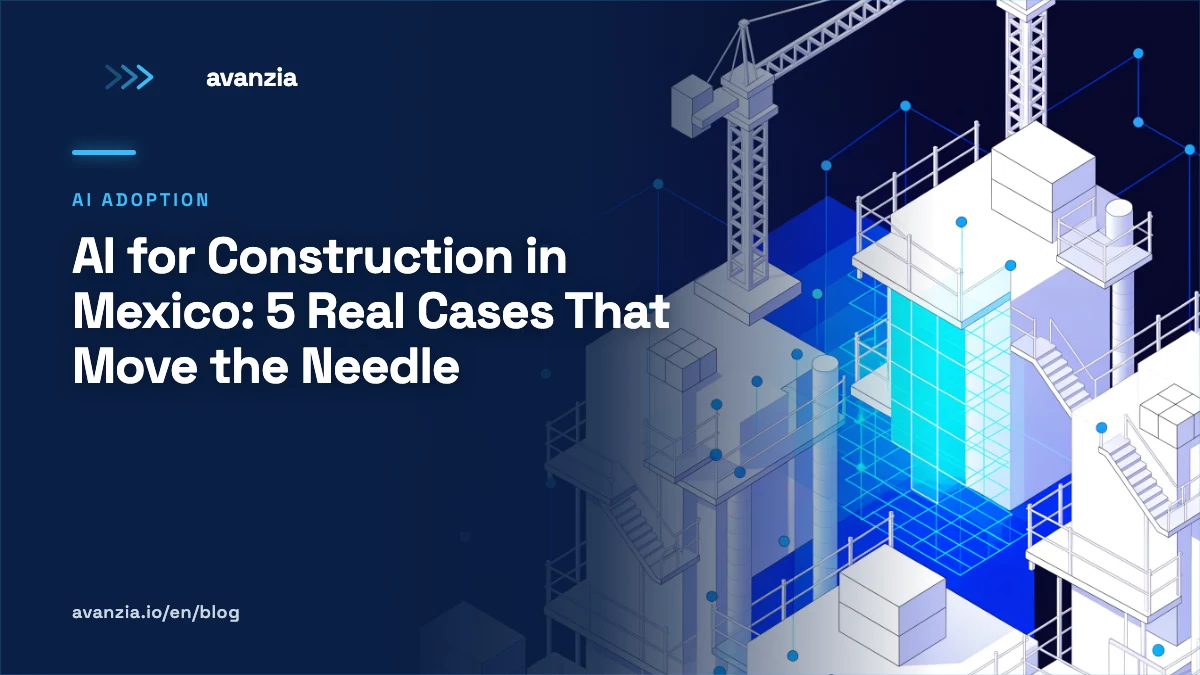
AI for Construction in Mexico: 5 Real Cases That Move the Needle
Five real cases of AI in Mexican construction that actually move the needle: computer vision, cost prediction, automated bids, and more. No magic promises.
Mario VelázquezMay 29, 20268 min
# AI for construction in Mexico: 5 real cases that actually move the needle
Construction is one of Mexico's largest industries. According to INEGI, it accounts for roughly 6.5% of GDP. It is also one of the slowest to adopt technology. A mid-sized bank may already run 30 AI agents in production, while a 200-person builder still prices jobs in a 2014 Excel sheet and shares progress reports over WhatsApp.
This isn't a judgment. Construction runs on tight margins, long cycles, and a level of operational improvisation that average software can't handle. But the gap is closing. The companies adopting AI today, not building it but **adopting** it, are already seeing real numbers.
At Avanzia.io we work from Puebla with clients in construction, real estate, and industry. These are five AI use cases in construction that deliver measurable results, based on what we see in the field. No magic promises. No "AI will transform your job site." Just what works and why.
## 1. Automatic progress measurement with computer vision
**What it is:** You take a photo of the job site each morning, or a drone does it, a vision model analyzes the image, and it tells you how much you advanced, which materials were used, and whether you're off schedule.
**Why it matters:** In most Mexican construction firms, the weekly progress report is still a PDF the site manager assembles on Friday at 7 PM with phone photos. What that report measures is opinion. What AI measures is quantified reality.
**Real case:** A builder we work with went from 2-page weekly reports to a daily dashboard with percentage progress per line item. The change caught an 11-day delay in foundations that had been hidden behind "we're fine" for three weeks. Cost: zero. The team was simply retrained to upload photos to a folder.
**How you adopt it today:** You don't need an ML team. Commercial APIs (Anthropic Claude with vision, GPT-4o, Google Gemini) already produce reasonable analysis of site images. The work is assembling the flow: camera, storage, analysis, report. An agency builds that in 4-6 weeks.
## 2. Predictive analysis of cost overruns
**What it is:** A system that cross-references your line-item catalog, the financial progress curve, and market prices for inputs, then warns you, before it blows up, which item will go over budget.
**Why it matters:** Cost overruns in construction don't show up the day they blow up. They show up in weak signals three months earlier: a supplier who starts raising prices, labor output that drops 3%, a small project change nobody quantified. A person can't monitor this across 8 simultaneous jobs. An agent can.
**What we see in the field:** Implementations like this in mid-sized firms (between 50 and 200 million pesos in annual volume) recover between 1.5% and 3% of total cost. On an 80-million-peso job, that's 1.2 to 2.4 million pesos. The typical investment to get this running: between 200,000 and 400,000 pesos. Payback: one job.
**The trick:** It isn't the AI. It's having clean data. If your line-item catalog lives in an Excel file with merged cells and inconsistent names, you fix that first. AI is the final layer, not the first.
## 3. AI assistant for bids and technical proposals
**What it is:** An agent that reads the terms and conditions, the bid documents, and the line-item catalog, then drafts the technical proposal in hours instead of weeks.
**Why it matters:** A typical builder's bidding team spends 60% of its time on repetitive tasks: reading specs, copying requirements, assembling data sheets, rewriting the same "company experience" section with different words. A well-configured LLM does all that in 10 minutes.
**What it doesn't do:** Decide whether to bid or not. That stays a human call, made with commercial and financial judgment. AI speeds up **document production**, not **strategic judgment**.
**Realistic implementation:** You need two things. First, a well-structured knowledge base with your past proposals, data sheets, and staff résumés. Second, a human review step before sending. If you do only the second (the agent) without the first (the base), the output will be generic and uncompetitive.
## 4. Safety and quality inspection with computer vision
**What it is:** Cameras (fixed or helmet-mounted) that detect in real time whether workers are using PPE, whether there are unsafe conditions, or whether a masonry joint is out of tolerance.
**Why it matters:** In Mexico, the STPS reports more than 600,000 workplace accidents per year. Construction is in the top 3 for incidence. Current models detect a missing helmet, a poorly fitted harness, or personnel in restricted zones with accuracy above 95%.
**What's realistic:** It isn't 100% prevention. It's risk reduction and, above all, auditable evidence. If your company faces an inspection or an incident, having three months of automated PPE-compliance logs completely changes the conversation with the authority or the insurer.
**Cost:** Industrial IP cameras with this software layer cost between 8,000 and 25,000 pesos per point. For a large job, you're looking at 200,000 to 500,000 pesos. The savings on insurance premiums and incident-related costs usually justify it in under a year.
## 5. Customer service and after-sales agents
**What it is:** A WhatsApp or web agent that answers frequent customer questions, like construction progress, delivery dates, deed paperwork, and warranties, without going through a person.
**Why it matters:** If you sell housing or developments, 70% of the questions your sales team gets are repetitive. If you build for third parties, the same applies to post-delivery follow-up. That 70% is absorbed by an agent. The remaining 30%, the real questions, complaints, and complex situations, stays with a person. What changes: the person focuses on what matters.
**What we don't recommend:** Putting an AI agent on the front line of complaints. When a customer is upset because their delivery is 2 months late, talking to a bot makes them angrier. AI handles the cold questions; people handle the hot ones.
**Typical case:** A developer we work with went from 4 people in customer service to 2, not because anyone was let go but because the other 2 now do proactive follow-up with clients in the deed-signing phase. Final-payment collection rose 18% in one quarter.
## What doesn't work (worth knowing before you spend)
Three failure patterns we see repeatedly in construction:
**Buying AI before having data.** If your job-site reports still live in loose sheets, don't hire anyone to build you a predictive dashboard. Fix the base first. AI without clean data is decoration.
**Adopting AI without involving the operations team.** The site manager is the one who will use (or sabotage) the tool. If management buys the software without asking them, it fails. Period.
**Confusing "having a chatbot" with "having adopted AI."** A poorly configured WhatsApp chatbot is noise, not adoption. Real adoption involves processes, metrics, governance, and team training. The software is 20% of the work.
## How to start without wasting money
The approach we use at Avanzia with construction clients is this: we find a painful process that's high in frequency and low in risk. We partially automate it with AI. We measure. We iterate. We don't move to the next one until that process delivers consistent results.
Three good processes to start with in Mexican construction: progress measurement from photos, a proposal assistant for bids, and a WhatsApp agent for frequent questions. All three have measurable ROI in under 6 months and don't require redesigning your operation.
You don't need a Chief AI Officer. You need an honest diagnosis of where it hurts, what data you have, and which tools available today connect to that. That's what an AI-adoption agency does, and it's what we do at Avanzia.
## Closing
AI in Mexican construction isn't about robots building houses. It's about your team dropping repetitive work, making better decisions with real data, and protecting its people with technology that's already available and affordable. Adopting before your competition is the advantage. Waiting three more years to "see how it matures" is handing over market share.
If you want to understand exactly which processes in your construction company are candidates for AI adoption, which ones have clear ROI and which ones are traps, **I'm offering a free 45-minute diagnosis**. I leave with a map of three prioritized processes and an estimate of investment and return. No hard sell. If there's no fit, I'll say so straight.
Schedule it by writing to me directly at **mario@avanzia.io** or via WhatsApp. We work from Puebla with national clients in construction, real estate, and industry.
—Mario Velázquez, founder of Avanzia.io