From Chaos to Data. From Data to AI.
"We want to bring in AI" is how almost every conversation starts. Our first question is always a different one: what trustworthy data do you have about your operation today? Why Avanzia's path is always two legs, in this order.
Almost every conversation we have with a company starts the same way: "we want to bring in AI." And almost every one takes the same turn when we ask our first question: what trustworthy data do you have about your operation today?
Silence. Not because there's no work — there's plenty. There are orders, deliveries, customers, WhatsApp messages, spreadsheets, notebooks. What there isn't is a digitized, measurable, auditable process that produces a number everyone trusts.
The glass that keeps overflowing
Picture pouring water into a full glass. And then pouring some more. That's what an operation without process looks like: time, money and effort spilling over every single day on tasks that could run on their own. The uncomfortable part isn't the spill — it's that nobody has measured how much is spilling, because there's nowhere to get the number from.
That's the real problem for most mid-sized companies we meet. They're not missing AI. They're missing the floor to stand it on.
Leg one: from chaos to data
That's why our path is always two legs, and the first one has nothing magical about it. It's consulting and process implementation: understanding how the operation actually runs, digitizing what lives on paper and in people's heads, and leaving every step measured and auditable.
When that leg is done, something happens that changes the conversation: waste stops being a feeling and becomes a figure. How many hours go into capturing the same thing twice. How many orders fall through between departments. What "I thought you were handling it" actually costs. With the number in front of you, deciding what to automate first stops being a bet.
We've seen it across very different operations: an industrial fleet that made tire purchases on gut feeling until every inspection became a data point; a repair shop running on paper and memory until every job became a documented file with evidence; a clinic network that didn't know how long patients waited until the whole process was measured. In every case, data came first.
Leg two: from data to AI
The second leg is where AI finally does its thing — and where it genuinely feels like magic. A bot that doesn't just reply, but qualifies leads and follows up by rules. Reports that build themselves. Processes that run even when nobody remembers them. But none of it is magic: it's the same data from leg one, put to work.
AI built on top of a chaotic operation is like a building on rotten wooden stilts: modern above the waterline, sinking below it. AI built on data is a different thing entirely — every bot answer, every report, every automation has something solid to hold on to.
Why we don't start the other way around
We know the reverse order sells faster: promise the AI first, fix the foundation "later." We also know how it ends: impressive demos and operations that stay exactly the same. We prefer the more honest path even if it takes a bit longer, because it's the only one that leaves something standing.
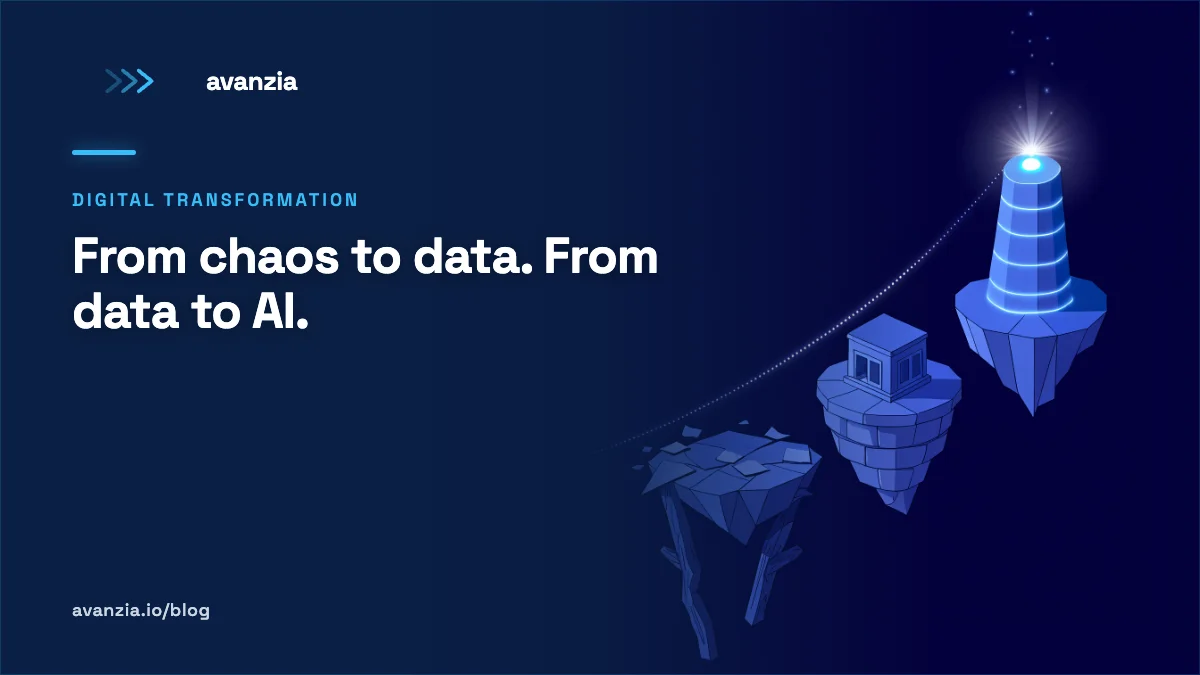
From chaos to data. From data to AI. In that order, skipping nothing.
If your operation looks more like the overflowing glass than the stone tower, talk to us. The first step isn't buying tools: it's putting a number on what's being wasted.