How We Redesigned the Avanzia Logo With AI and Shipped It
We used Claude AI to design a full brand system from scratch — the Motion Trail logo, palette, and typography — and shipped it straight to our site. Here is how we did it.
When your own logo stops representing you
Avanzia started as an idea in a notebook. The original logo showed exactly that: a sketchy, hand-drawn wordmark. It worked when we were a personal project. It stopped making sense once we began closing contracts with industrial, automotive, and healthcare companies in Puebla.
The problem was not only aesthetic. We position ourselves around technology, AI, and automation. Our logo looked like it was made in Paint. Every time I sent a proposal or opened a pitch deck, the logo undercut the credibility of our work. We needed a change. We had no budget for a branding agency and no weeks for a traditional process.
So we did what we do best: use AI to solve a real business problem.
The experiment: designing a brand with Claude
Instead of hiring an agency, we used Claude (Anthropic's AI model) as our creative director. This was not a "make me a nice logo" prompt. It was a structured process across several sessions where we:
- Defined the brief: We told Claude who we are, what we do, our market (mid-size companies in Mexico), and the feeling we wanted to convey: advanced but approachable technology, forward motion, professionalism without cold corporate stiffness.
- Evaluated 5 concepts: Claude generated five distinct creative directions — Minimal Wordmark, Signature .io, Forward Chevron, Vector Mark, and Geometric Slice. Each concept came with its visual logic, a suggested palette, and its application.
- Chose with criteria: This was not only my call. My wife and I scored each concept against three questions: does it reinforce the name "Avanzia" (to move forward)? Does it work at 16px in a favicon? Does it feel tech and premium without being generic?
- Iterated the winner: The "Forward Chevron" concept won, but it needed refinement. We tested three variants (A, B, C). Variant C — "Motion Trail" — captured the idea of progressive movement best.
The result: Motion Trail
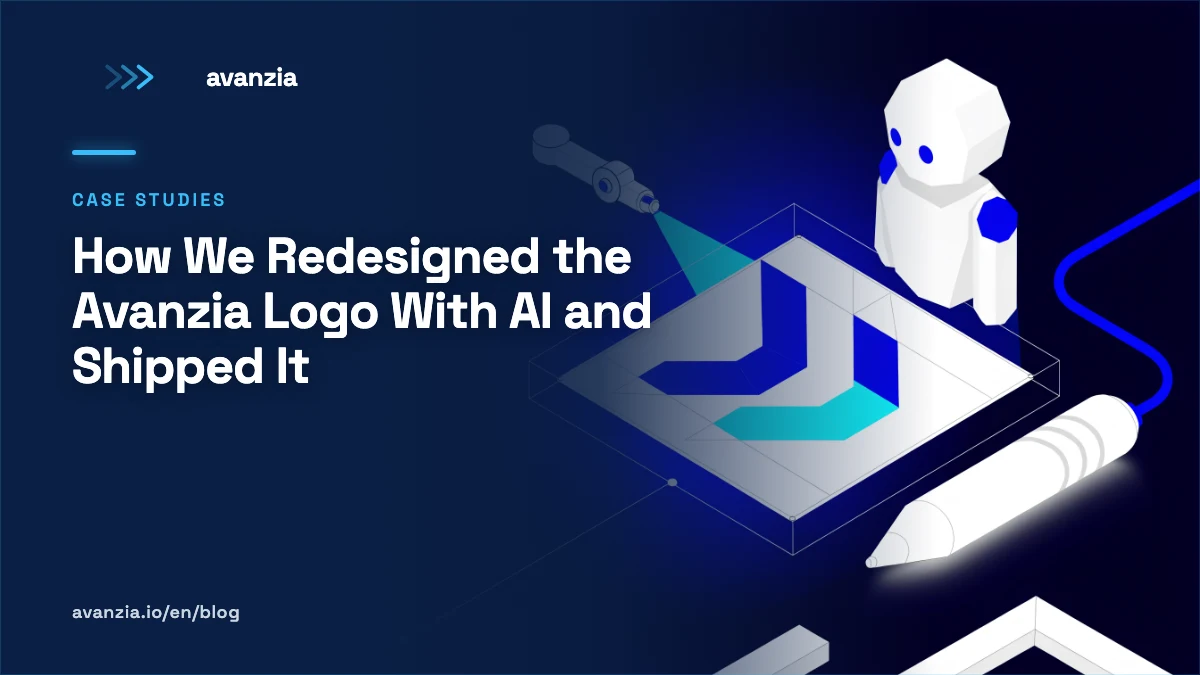
The final logo is a system of three chevrons with progressive opacity (25% → 55% → 100%) that create a trail of movement, paired with the "avanzia" wordmark set in Space Grotesk. The visual metaphor is literal: advance, progress, move forward.
But a logo is not just an icon. Claude helped us design a complete brand system:
- Two official variants: The primary one (full trail) for normal use, and the reduced one (single solid chevron) for favicons, app icons, and small sizes.
- Color palette: Avanzia Navy (#0A1F44) as the base, Avanzia Blue (#2563EB) as the main brand color, and Electric Blue (#38BDF8) as the accent. No pure black — always navy.
- Typography: Space Grotesk for titles and display (weights 500/600/700), Inter for body text (weights 400/500/600). Both are Google Fonts, free and optimized for the web.
- Animation system: Reveal on load (0.85s), a subtle loop in hero sections (2.4s), and a header hover where the chevrons advance 12-20px. All of it respects
prefers-reduced-motionfor accessibility.
From Figma to production in the same day
This is where the story gets interesting for other founders. We did not only design the brand with AI — we implemented it with AI too.
We used Claude to generate the logo's SVG code with the exact opacities, the CSS animations, and the React components we needed to integrate it into our Next.js site. The flow was:
- Optimized SVG: Claude generated the logo SVG with the three chevron layers and the correct opacities, production-ready.
- React component: A reusable component that accepts variant (full/reduced), size, and mode (light/dark).
- CSS animations: The reveal, loop, and hover transitions built with
@keyframesandtransition, not heavy libraries. - Favicon and meta tags: We generated the favicon in several sizes (16px, 32px, 180px for the Apple Touch Icon) from the reduced variant.
- Deploy: Push to Git → Netlify auto-deploy → new logo in production.
Less than 4 hours passed from the final logo decision to seeing it live on avanzia.io. No Figma, no Illustrator, no back-and-forth with designers. AI from start to finish.
What we learned
This exercise left us three lessons that apply to any company considering AI for its brand:
1. AI does not replace judgment, it amplifies it. Claude generated sharp options, but the final call was human. We scored on business criteria, not only aesthetics. AI cut the exploration phase from weeks to hours.
2. The system matters more than the logo. A logo alone solves nothing. What solves the problem is a system: a defined palette, consistent typography, clear usage rules. Claude helped us think in systems from the start, something many agencies leave for later phases.
3. Dog-fooding is the best marketing. An AI agency using AI to redesign its own brand is not only efficient — it is the most direct proof that what we sell works. Now when a client asks "does AI really work for my business?", we show them our own case.
Want to do the same for your company?
If your brand no longer reflects who you are or where you are going, you do not need a 3-month process or a six-figure budget. With a clear brief, business judgment, and the right AI tools, you can have a professional brand system in days.
At Avanzia we help companies in Mexico adopt AI in practical ways — from internal operations to the face you show the world. If you want to explore how AI can transform your business image, get in touch.