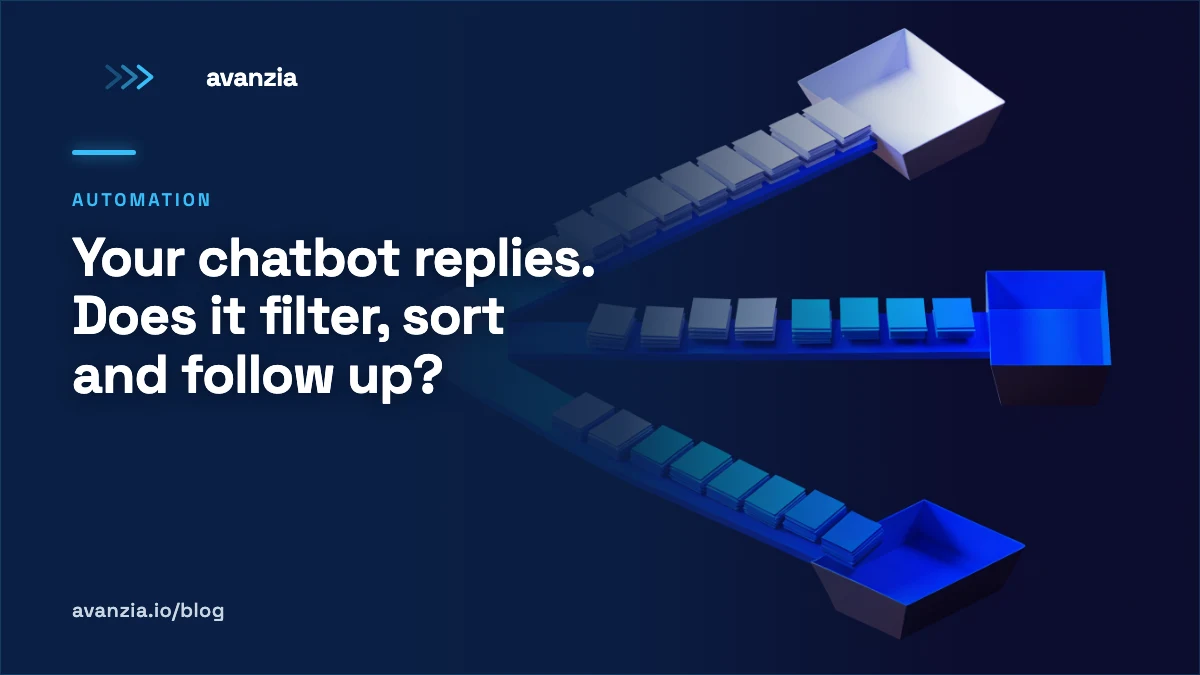
Your chatbot replies. Does it filter, sort and follow up?
Answering fast is the easy part. What separates a useful chatbot from a faster inbox is what it does next: filter prospects, sort leads and come back with rules. How we run it for Marcas de Puebla, Marlene Rivera and Avanzia.
Almost any business can have a chatbot this week. You buy the tool, paste in your FAQs, connect it to WhatsApp, and it answers.
A month later the uncomfortable question is a different one: of everyone who wrote in, who were real prospects? Who followed up? Where did what they asked for end up?
That's where most of them fall apart. Not at answering. At what happens after the answer.
Answering is the easy part
A bot that only replies solves a real problem: no message sits unread at ten at night. But it leaves the expensive one untouched.
Conversations pile up with no order. The team can't tell the browser from the buyer. Intent gets mentioned once, loose in a message, and goes nowhere. And when someone goes quiet mid-conversation, nobody comes back.
A chatbot that doesn't filter, sort, and follow up isn't customer service. It's a faster inbox.
Filtering: separating the prospect from the noise
Filtering isn't blocking. It's deciding what the bot resolves, what needs a person, and what should never be answered at all.
In the bot we built for the auto shop Marcas de Puebla, that decision is written rule by rule. Checking a repair's status requires identity: if the number is already linked to a customer, it sees only their own orders; if not, it has to provide an order number and matching license plates. Tire quotes are answered against real inventory, using the sale prices the shop defined. And when someone asks for a human, the bot pauses for thirty minutes and gets out of the way.
The most valuable rule is usually the one that prevents an answer. Vale, the assistant for Marlene Rivera Makeup, never confirms availability: it has no access to the calendar, so it records the request and says someone will confirm. It used to say "yes, we can" with a full schedule. A bot that overpromises costs more than one that stays quiet.
Sorting: so intent doesn't die inside an email
The shop's first bot did what most of the market does: when it detected a lead, it sent an email with a name and a phone number. The actual intent — what they needed, for which vehicle — was mentioned in the conversation and lost there.
Today every lead is stored with name, phone, intent, vehicle, entry channel, and a status the team moves by hand: new, contacted, customer, discarded, or ignored. Opening a lead also shows the full conversation that produced it.
The difference is practical. With an email, the salesperson calls without knowing whether it's a tire or a transmission. With a sorted record, they know what was asked, which channel it came from, and who already reached out.
Following up: where the money is lost
Prospects rarely get lost for lack of an answer. They get lost for lack of a second answer.
Our own bot runs a follow-up module that checks every fifteen minutes for conversations left hanging. The AI decides case by case: if it's a real prospect, it writes a message that picks up what they were asking about; if it was a wrong number, spam, or someone who said no, it turns follow-up off permanently.
And it has brakes, because follow-up without rules is called spam:
- Two messages maximum: one after an hour, one the next day. There is no third.
- Only between 7:00 and 20:00, Puebla time. Nobody gets a reminder at dawn.
- It cancels itself if the person replies or if a human takes over the conversation.
Those three rules are the product. Writing the message is the part anyone can do.
Omnichannel is one brain, not four bots
Omnichannel gets sold as a row of logos. In practice it's an architecture decision: the brain knows nothing about channels. Each channel only translates messages in and out; the knowledge, the rules, and the history live in one place.
That's how the three we run today are built: Marcas de Puebla handles WhatsApp and the chat on its site; Vale handles Instagram, Messenger, and Marlene's web chat; ours handles all four. In every case, one inbox and one database.
The advantage shows up when something changes. You fix a pricing rule once and it applies across every channel. A prospect who wrote on Instagram and comes back on WhatsApp doesn't start from zero. And adding a new channel doesn't mean rewriting the bot.
Generic tools don't know how you work
Vale always asks "what time do you need to be ready?", never "what time is the event?". It looks like a wording detail and it's the opposite: Marlene arrives beforehand to do the makeup, so the ready-by time is the only data point you can actually schedule around.
That same bot sells skincare from a live catalog of more than a hundred products with their prices. The table also stores cost, which is the business's margin. The bot is forbidden from reading that column.
Something similar happened at the shop: for the first few days the bot quoted tires at cost prices, until the business's real pricing rules were written down.
None of those rules come in a template. They come from sitting with the person who handles customers every day and asking how quotes are made, what is never promised, and which information doesn't leave the building. A tool designed for every business can't know that, because not knowing is its job.
Owning your data isn't a technicality
The conversations are the asset. They hold how your market asks, in what words, at what hour, which doubt shows up right before buying, and where the sale falls apart.
On July 29 four new Messenger conversations came into Marlene's bot. One was a bride asking for pricing for a December 26 wedding outside Puebla. In that single conversation the bot made three mistakes: it didn't give the price that was already published on the site, it asked the wrong time question, and it didn't know about the travel fee. All three were fixed that same day.
That's only possible if the conversations sit in your database and the bot's knowledge is edited by the business. At the shop, that knowledge is four editable blocks in the admin panel; a change is live in five minutes, with no code and no ticket.
When we built ours we evaluated off-the-shelf platforms and chose to build. The reason wasn't technical: it was keeping the data, the product, and the margin in house.
What it looks like when it's done right
- Every channel lands in the same inbox and the same history.
- The bot knows when to stay quiet and hand the conversation to a person.
- Every lead has intent, channel, status, and the conversation that produced it.
- Follow-up has a schedule, a cap, and an automatic off switch.
- The business edits its own rules, the same day.
- The database is yours. If you change technology partners tomorrow, you take everything with you.
Start with the process, not the tool
The first question isn't which platform. It's what people ask you, what turns someone into a prospect, who handles them, what gets promised, and what happens when they stop replying.
With that written down, the tool is a consequence. Without it, any tool gives you the same thing: fast answers and a contact list nobody uses.
It's literally our process: we listen, we define, we develop, we expand. If you want to see what this would look like in your operation, let's talk. And if you're starting from scratch, here's our guide to implementing an AI chatbot.