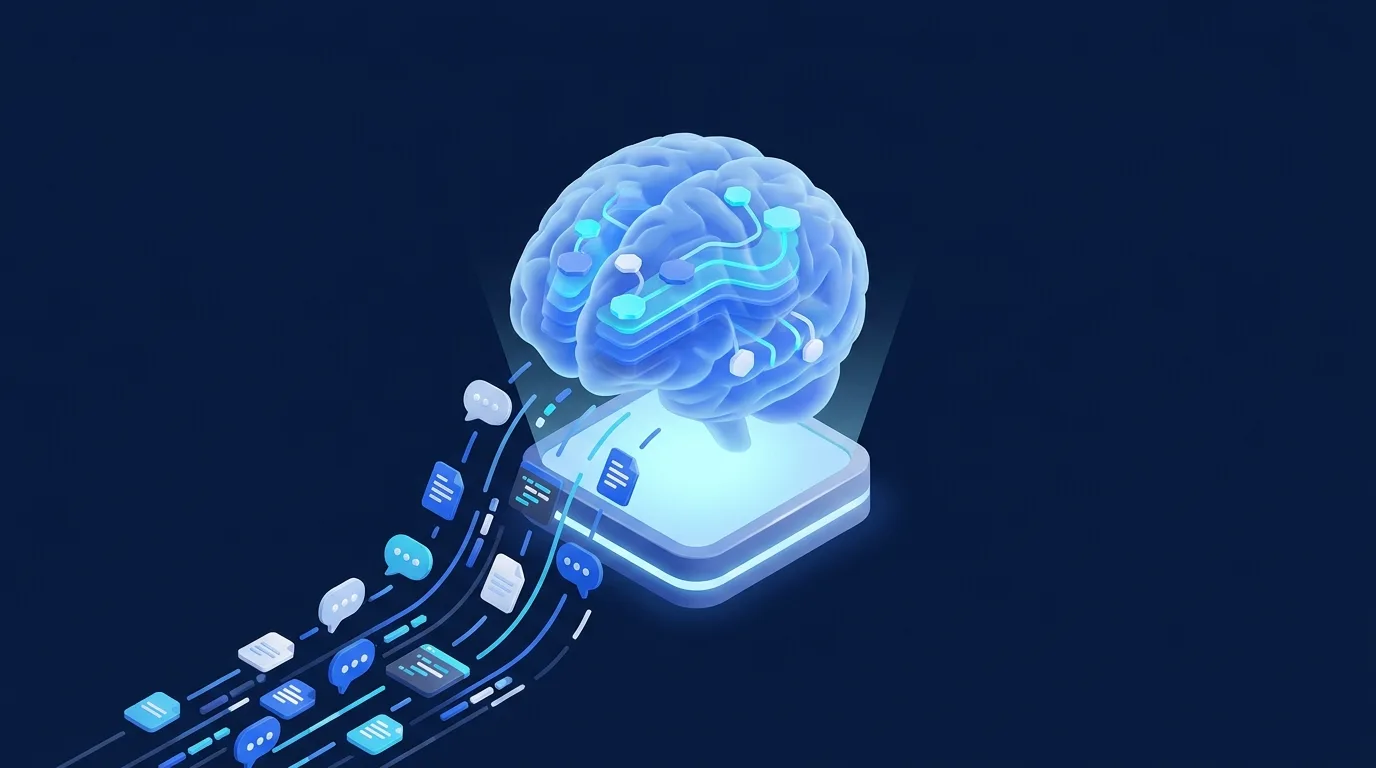
We built our own AI second brain — and it turned into a product
We had a problem: what we worked on each day kept slipping away. So we built a system that captures and distills our work on its own — and why it works for any company.
What started as an internal problem became an idea that works for any company.
At Avanzia we run several fronts on the same day. It is not an exaggeration: a normal day touches six or eight different builds, each with its own partner, context and decisions. And by the end of the day, much of that evaporated.
Not the code — that stays in the repo. What got lost was the why: the decision we made, the data point that changed course, the problem we uncovered at eleven at night. That knowledge lived in our heads, and heads forget.
We wanted to document what we do without stealing time from the work. So we built it.
The material already existed
The first surprise was realizing we did not have a capture problem. We had it solved without knowing it.
Every work session with our AI tool was already saved, automatically, on the computer. When we looked, there were more than 800 sessions recorded, one for every work conversation. The full history of what we do, raw, waiting.
The problem was not capturing. It was distilling: turning that noise into something readable and useful.
What we built
A process that runs on its own, every night, without anyone triggering it:
- It reads every session of the day, across all projects at once.
- It distills each one with AI into a short journal: what got done, what was decided, what is still open, what broke.
- It proposes content: it flags the stories worth a blog or a video, with the angle already thought out.
We gave it one golden rule: if the computer is off one day, the next time it turns on it backfills the missing days. Nothing is lost for not being there.
Proof that it works
The first day it ran, it distilled nine sessions in parallel across eight different projects. And among all of it, it rescued a story we were already forgetting.
A partner asked how much their messaging cost would rise if they opened their whole operation instead of part of it. The intuitive answer was “it triples.” The journal, by forcing us to revisit the record, revealed the real answer: zero. Because of how their systems were connected, opening the rest generated not a single new message. The real limit was something else — a technical performance detail — that no one had named.
That is the difference between a system that only stores and one that makes you see. We did not accept the first number. The second brain forced us to find the right one.
Where it stopped being ours and became everyone's
A week into using it, the conclusion was obvious: this problem is not ours, it is every company's.
Every company produces the same kind of knowledge that slips away every day. The WhatsApp conversations with their clients. The meetings. What happens inside their systems. It lives in people's heads, and when someone leaves, they leave with everything they knew.
So we named it: Memoria Viva. An AI layer that captures what your business already produces — without anyone writing reports — and every day turns it into three things:
- Searchable memory. What happened stays searchable. “What did we agree on in March?” gets answered in seconds.
- Insights. It detects what repeats, what gets stuck, what no one manages to see.
- Ready content. It turns your operation into summaries, FAQs and material, without starting from scratch.
The key: it is not a tool you have to feed. It runs on what you already generate.
Why we are telling this
Because this is how we work. When an idea solves a problem of our own, we build it, we test it on our own operation, and if it works, we take it to whoever needs it most. From idea to production.
Memoria Viva exists because we needed it first. If your company also feels knowledge slipping through its fingers, let's talk.