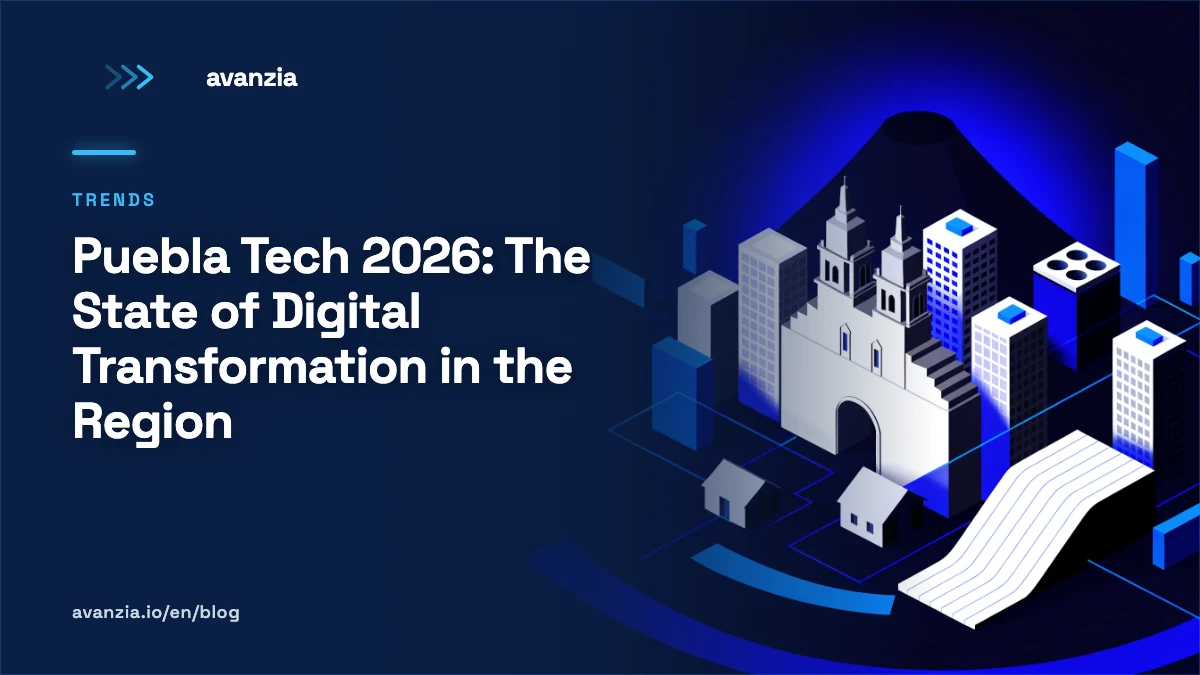
Puebla Tech 2026: The State of Digital Transformation in the Region
Digital transformation in Puebla is no longer optional. It is reshaping how local companies compete, grow and create value. Here is the current picture, the sectors moving first, and what you should do now to avoid falling behind.
Digital Transformation in Puebla in 2026: Where Do We Stand?
Five years ago, digital transformation sounded like a Silicon Valley idea with little to do with Puebla's businesses. Today it is the most pressing conversation in the offices of the Centro Histórico, the corporate towers of Angelópolis and the industrial plants of San Martín Texmelucan. In 2026, the gap between digitally mature companies and those still running analog processes has become visible. Ignoring it now carries a concrete cost: lost customers, slower operations and thinner margins.
At Avanzia we have spent two years working directly with mid-sized companies in Puebla, deploying AI agents, automations and digital systems. What we see on the ground gives us a clear view of the real state of digital transformation in the region, beyond corporate reports and conference talks.
The Sectors Moving First on Digital Transformation in Puebla 2026
Not every industry moves at the same pace. Puebla's industrial base, long shaped by manufacturing, automotive and textiles, is going through an uneven shift. Understanding it helps you place where you stand.
Manufacturing and Industry: Fast Adoption
The Puebla-Tlaxcala industrial corridor is perhaps where the most tangible change has happened. Suppliers to the automotive assembly plants had to adopt traceability systems, digital quality control and real-time communication because their clients demanded it. The result is an industrial base that already handles production data, but mostly does not yet know how to draw intelligence from it.
The opportunity: deploy AI agents that analyze existing production data to predict failures, optimize shifts and cut waste. Companies that have done this report savings of 15-25% in operating costs.
Professional Services: The Biggest Lag
Accounting firms, law offices, consultants and marketing agencies still run largely on Excel, WhatsApp and email as their main management tools. In 2026, that lag is expensive. Competitors who adopted a CRM, proposal automation and digital follow-up are closing two to three times more projects with the same team.
The barrier is not technical. It is cultural and tied to the upfront cost. A well-implemented CRM with an AI agent that follows up with prospects automatically can cost between $6,000 and $15,000 MXN per month. It also acts as a real revenue multiplier within 90 days.
Commerce and Retail: Omnichannel as the Standard
The stores that survived the pandemic and thrived share one trait: they built digital channels that complement the physical point of sale. In Puebla, retail now splits clearly between operators with e-commerce, WhatsApp Business and inventory automation, and those still relying on foot traffic from downtown or Plaza Dorada.
The most telling figure: in 2026, Puebla has one of the highest digital payment adoption rates among mid-sized cities in Mexico, with more than 68% of point-of-sale transactions processed digitally. Consumers are ready. The question is whether businesses are.
The 3 Real Barriers to Digital Transformation in Puebla
After dozens of conversations with business owners in Puebla, the same three barriers come up again and again. They are not the ones you usually find in McKinsey articles, but they are the real ones.
1. Confusing the Tool with the Strategy
Many companies buy software without knowing which problem they are solving. "We need a system" is the most dangerous phrase in digital transformation, because it assumes technology does the work on its own. A poorly implemented ERP, a CRM nobody uses, or an app that duplicates the paper process are wasted investments.
Digital transformation starts with an honest review of your processes, not with a software demo.
2. Digital Talent as the Bottleneck
Puebla has four major universities with computer science and engineering programs. Even so, demand for digital talent far outpaces the local supply. The companies that manage to hire strong technical profiles lose them to Mexico City, Monterrey or remote work for foreign firms that pay in dollars.
The approach gaining the most traction in 2026: AI agents as a complement or partial substitute for repetitive technical roles. This is not about replacing people. It is about multiplying the capacity of the small teams already in place.
3. The ROI Nobody Can Calculate
Investing $50,000 MXN in machinery has a clear ROI. Investing $50,000 MXN in "digital transformation" creates uncertainty. That perception can be overcome, but it is one reason many companies postpone decisions they should have made already.
The antidote: start small, measure fast. An AI agent that automates quotes can show results in 30 days. A customer follow-up system can prove its value in the first month. The key is to design each initiative with success metrics defined from the start.
What Should Your Mid-Sized Company in Puebla Do Now?
Based on what we see working in real companies, here is the order of priorities for 2026:
- Digitize your data first. If your critical processes still live on paper or in WhatsApp threads, no AI system can help you. The first step is always to structure the information.
- Automate the repetitive before the complex. Prospect follow-up, report generation, inventory updates. These processes have a clear, fast ROI.
- Treat AI agents as team members, not as a tool. In 2026, AI agents are not simple chatbots. They can run full processes, from answering a question to drafting a proposal and following up with the customer. Companies working with Avanzia run agents that do the work of two to three people on specific tasks.
- Measure everything from the start. Define what success means before you implement. Without metrics there is no learning and no case for the next step.
Puebla 2026: A Region with a Window of Opportunity
Puebla has an edge that few mid-sized cities in Mexico share: a solid industrial base, an active university ecosystem, a competitive cost of living versus Mexico City, and a business community that has long known how to adapt.
Digital transformation in Puebla in 2026 is far from complete. But it is underway, and the shift is irreversible. The companies that understand this today and act in the next six months will gain a real competitive advantage that will be hard to catch up to later.
At Avanzia we help mid-sized companies in Puebla design and deploy their AI-driven digital transformation strategy, from the initial review to the first agents in production. We do not sell software. We build systems that produce measurable results.
Want to know which stage of digital transformation your company is in? Book a call with our team and we will run a free 30-minute review.