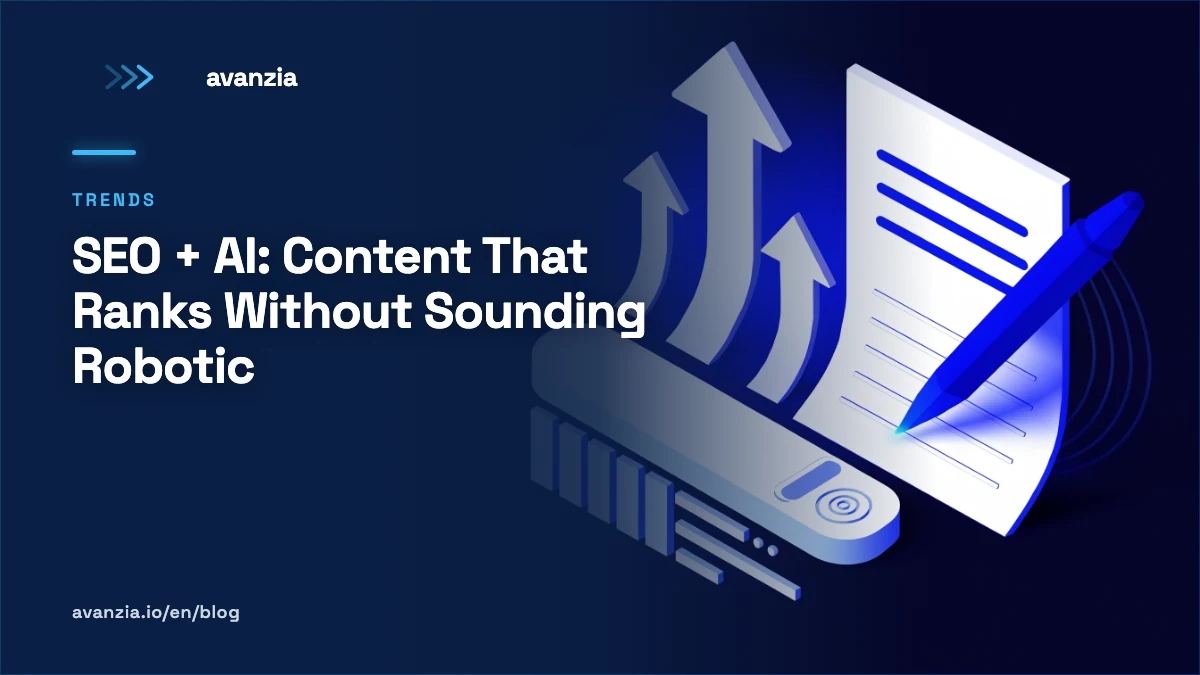
SEO + AI: Content That Ranks Without Sounding Robotic
How do you use AI to create content that ranks on Google without sounding like a machine? At Avanzia we share the framework we use with clients to scale content production while keeping authenticity and editorial quality.
SEO + AI: How to Generate Content That Ranks Without Sounding Robotic
Using AI to create content is already standard practice across most agencies and digital businesses in 2026. Still, more marketing teams keep asking the same question: how do I use AI to rank on Google without my content sounding like a machine wrote it? The answer is not to avoid AI-driven content. It is to direct it strategically so it strengthens your rankings without losing authenticity.
At Avanzia we have spent over a year putting AI agents into our clients' content workflows. What we learned, sometimes the hard way, is that AI is an amplifier. It scales whatever you bring to it. If you have editorial judgment, AI scales it. If you don't, it scales the noise.
The real problem with AI content and SEO
Google has been clear about its position. It does not penalize AI-generated content by itself. It penalizes low-quality content with no value for the reader. That changes the whole frame of reference.
The most common mistake we see in businesses that start using AI for content is this. They ask the model to "write an article about X," publish whatever comes out, and expect it to rank. The result is predictable. Generic text, no real experience, no proprietary data, no brand voice. Google classifies it for what it is: filler.
The point is not whether you use AI. It is how well you direct it and how well you enrich its output.
The framework we use at Avanzia: AI as draft, human as strategic editor
Our methodology for clients splits content creation into three layers:
1. Deep research before writing
Before we ask the model to write a single word, we invest time in real research:
- Competitor analysis: What is ranking for the target keyword? Which angles have they not covered?
- Search intent: Does the user want to learn, compare, buy, or solve a specific problem?
- Proprietary data: Do you have a client case, an internal metric, a real experience you can cite?
- Search Console: Which queries already get impressions but no clicks? That is where you find content opportunities with existing demand.
AI does not replace this phase. It is the work of a strategist.
2. AI for structure and volume, human for substance
Once you have the full brief, the keyword, the intent, the differentiated angle, your own data, you can use AI to generate the article structure and fill in sections. But the right process is:
- Generate an outline with the AI
- Review and adjust the outline with editorial judgment
- Ask the AI to develop each section separately, with specific instructions
- Insert your data, examples, and perspective into every key section
- Rewrite the introduction and conclusion in your own voice
The final result should be an article where AI did the heavy lifting on structure and the first layer of text, but where your voice, your data, and your judgment are what make it valuable.
3. Technical optimization after writing
With the content ready, a set of technical adjustments decides whether it ranks:
- Keyword in the first paragraph, in at least one H2, and in the meta_description
- Natural density: no more than 1-2% keyword density. Keyword stuffing never worked well, and with AI it is easy to fall into it if you don't check
- Semantics: include variations and related terms that Google associates with the topic (LSI keywords)
- E-E-A-T: Experience, Expertise, Authoritativeness, Trustworthiness. Google rewards those who show real experience. Add first-hand data, quotes from real experts, or verifiable statistics
- Internal linking: connect the article to other relevant pages on your site
The role of AI agents in a scalable content strategy
One reason we build content automation workflows at Avanzia is that consistency is one of the biggest challenges in content marketing. Most teams produce in bursts, a lot of content one month and nothing the next, and that destroys domain authority.
AI agents let us set a sustained publishing rhythm, because they can run parts of the process on their own: research long-tail keywords, generate structured drafts, push articles into the CMS as drafts, and notify the editorial team for final review.
The results we have seen with clients who implement this workflow correctly:
- From 2 articles/month to 8-12 articles/month without growing the team
- Production time per article cut from 4-6 hours to 1.5-2 hours
- Organic traffic up between 40% and 120% within 90 days
But again: this only works when a human editor supervises and enriches the output.
Signs your AI content is losing authenticity (and how to fix it)
These are the most common warning signs we find when auditing the content of new clients:
- "In today's fast-paced digital world..." — The classic AI opener. Always delete it.
- Generic lists of 10 points with no specific context for your industry or market
- No first person at all: if the article never says "we," "our clients," "what we learned," there is no detectable human experience
- Claims with no source: "Studies show that..." without naming which studies
- Empty conclusions: closing paragraphs that just repeat what was said and add nothing
The fix is always the same: add real, specific experience. A concrete number from a real client. An implementation anecdote. A mistake you made and how you solved it. That is what Google (and your readers) look for.
Conclusion: AI + human judgment = a real competitive edge in AI content ranking
In 2026, not using AI in your content strategy is already a competitive disadvantage. But using it badly is just as harmful as not using it. The difference between AI content that ranks and AI content nobody reads comes down to one thing: who is at the wheel.
AI can generate 2,000 words in 30 seconds. What it cannot do is replace a strategist who knows their industry, knows their clients, and knows exactly what differentiated angle their brand has.
If you want to set up an AI content workflow that actually moves your rankings, Avanzia can help you design it. From keyword strategy to automating production and publishing.
Ready to scale your content without losing your voice? Book a call with our team.